


Last week, we launched our Annual Report, which we’ll be launching soon to a wider audience. For the next three weeks, we’ll be publishing key stories from that report followed by our usual Annual Book Review and reflection of the best articles of the year.
2025 is the year that AI ads started to become real alternatives.
Having an annual reflection is important because it highlights just how much (and how little) can change in a year. The production of ads is one of those key pillars.
Here are the learnings from our data, reflections on the year, and highlights of conversations we had.
Notes for references throughout
The data from our Annual Report is based on £11m of ad spend. The Annual Report launch was attended by 52 people – roughly a third of whom were clients.
AI is evolving fast, and this article is now out of date. For out most up-to-date thoughts on AI, read “Becoming AI Native” and “15 Claude skills and processes that have revolutionised Ballpoint”
20% of teams still use no AI
At the Annual Report launch, I asked people for a show of hands as to how much AI they used in ads.
The results?
100% AI – 2% of the audience
Majority AI (more than 50% of ads) – 10% of audience
Some AI (up to 50%) – 68% of audience
No AI – 20%
I wanted to dig into this and so have had multiple conversations over the last few weeks about this. Here are the core buckets of people:
AI doesn’t get approved because it’s not good enough
In many cases, these are the sorts of brands who get push back on creative anyway. Brands where creator content is still a discussion to be had rather than a default, and there is a push for brand consistency across social assets.
In this case, there is the view that AI creative is highly distinguishable, and not good enough. When pushed on whether if it was indistinguishable from non-AI creative whether it would still be used, the teams were mixed in terms of yeses and nos.
Ethical concerns
For some brands, the core issue is the big environmental cost associated with AI – and by actively using AI ads, you become an active contributor to that. For some of these brands they might either have the environment as core brand pillars or alternatively see it as in conflict of their B corp status.
Similarly, there are ethical concerns about a future creative joblessness created by AI.
Customer complaints
One thing we see a lot of is users on platforms being negative towards AI. Either ridiculing it for its silliness, or actively calling out the brand for its use. Common complaints are often those from the creative joblessness angle, but they are broad. One ad comment we saw this year called the brand “lazy at marketing” for using it.
The emergence of an AI-Free Corp
One of my predictions for 2026 is the emergence of a certificate or signal whereby you actively decide you won’t use AI.
The current global economy is full of businesses that offer premium or luxury experiences on top of otherwise commodity products. Take coffee as a core example, you can get coffee for very very little in a lot of places. Coffee is a commodity available to everyone, but over the last 15 years, the new coffee class has emerged.
Now, everyone wants something a little more premium, while there is still a coffee elite/snob that is lionised and catered for in a smaller selection of venues.
In short there is commodity + premium + luxury.
I think the same will become true for AI.
AI will become the de facto norm for a huge number of brands in advertising, and that will reach from commodity (likely the Meta’s offering) through to creative and well executed. And then alongside that, there will be a separate class of ‘No AI’ creative brands, who use that as a point of differentiation.
2026 prediction: The emergence of a certificate or organisation that shows you are “AI Free”
Either way, as it currently stands, the ‘no AI’ crew is bigger than the ‘all in’ crew. As for the middle: the ‘some’ vs ‘most’ I imagine this time next year, the ‘most ads are made with AI’ crew will become the norm.
AI ads make up a small amount of overall spend
There are two charts in the Annual Report that I thought were telling.
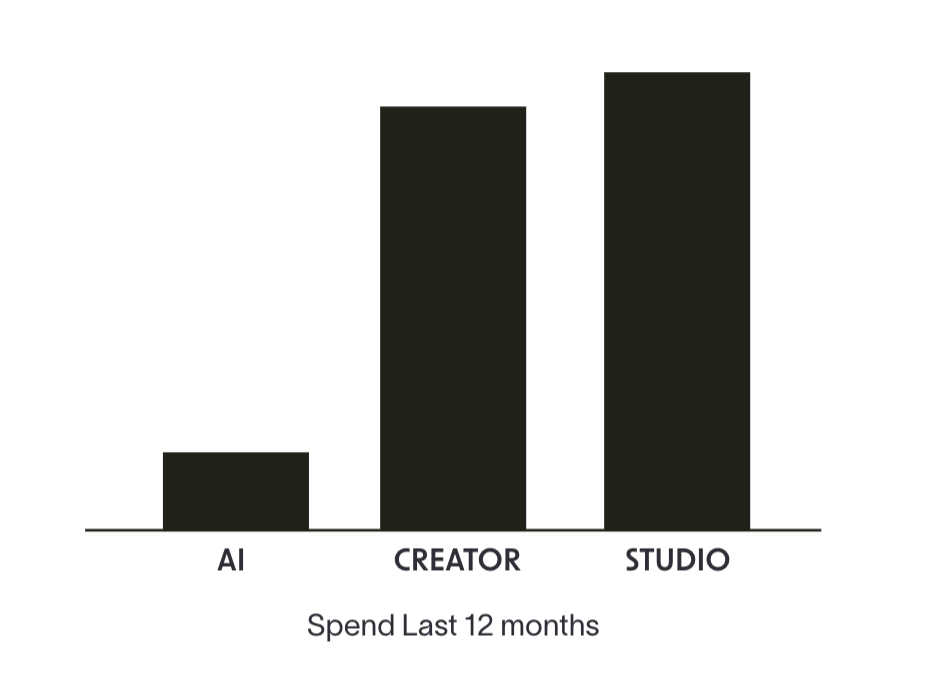
The first looks at spend across the last 12 months by production type.
For reference, we view each of these categories as “what is the majority of the ad made by.”
AI is made using an AI tool as a starting point
Creator is individual creator/influencer on their phone
Studio is person sat at a Mac with After Effects/Photoshop/etc
Now this reflects a few things. First, that AI has only become good enough this year. Second, that it’s still just a small percent of overall spend for the year.
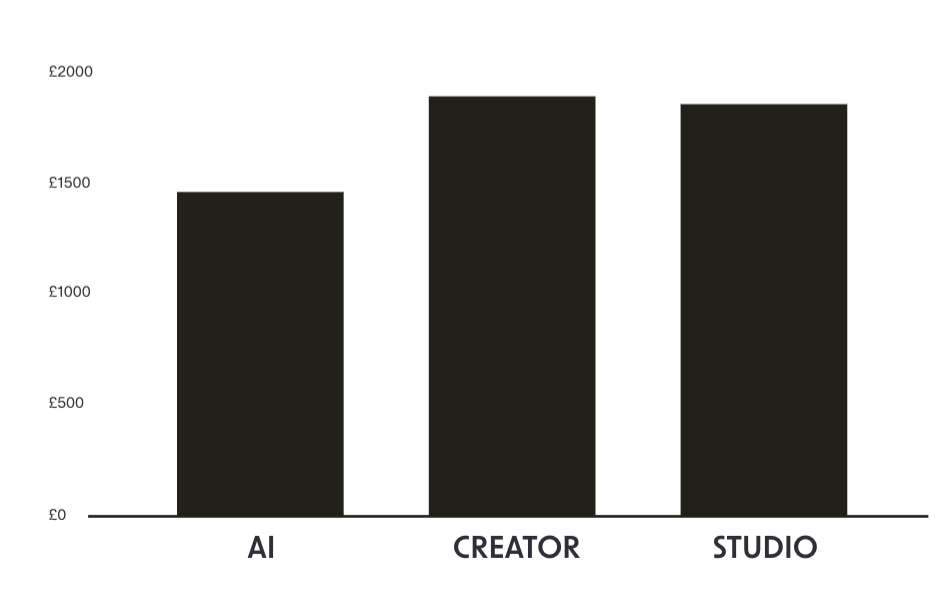
When you look at this on a “spend per ad” basis however, it changes.
Spend per ad is useful because it removes other variables like ‘number of assets made for each type’.
In this case AI is now at just 75% of the spend per ad as Creator or Studio.
That’s an incredibly close gap considering how underinvested in the category is.
We’ve had over a decade working on studio ads. And five years working on creator ads. But AI ads have only had experimentation for the last year.
It’s still super early. But once our learning, creativity, and experimentation with AI catches up, it promises something pretty impactful.
AI ads are some of our most creative
The most exciting thing from our side is that AI ads are very often where the best creativity is happening.
Take this example for our client YourParkingSpace.
Humour and satire are great in ads. When you think that ~99% of ads don’t add any humour to them, just a little can go a long way.
This was one of those curve ball ideas in a brainstorm that felt a little out there.
The premise?
YourParkingSpace helps people book parking spaces in advance of a trip. One of the potential ‘villains’ we came up with was the Traffic Warden, and soon the idea became ‘traffic wardens must hate it because it’s fewer tickets.’
This was all a bit of fun and a bit of comedy.
It’s also the sort of thing that over a year ago, would have been left in the brainstorm room.
Why? Because, to have made this ad would have probably cost £1,000, maybe a little more.
And on paper, the most likely thing that could happen is that this won’t work. And so even if we had taken it to the client, the majority of the times, it likely would have been left in the ideas column. (Regardless of who the client is I should say, this isn’t specific to them).
That’s smart – £1,000 for something with low probability, vs the other plethora of far more likely to succeed ads that cost nothing or just a few hundred quid is a no brainer.
But with AI, this ad was achievable for a few tokens while we perfected the scripting, the brief and the prompt. And it took a few hours to get it from idea to finished ad, and was live the following day.
This is just one example where AI has completely unlocked new levels of creativity.
Reframing how you see AI in creative
AI can save some money on making creative, sure. But that’s not its power.
It’s real power is unlocking whole new levels of creativity by helping you come up with ideas you couldn’t do before.
And for all the teams who fall into the anti-AI camp, some of those reasons are going to be non-negotiables, especially those on ethical grounds. But for those where it is a question of preservation of Brand Image, I’d recommend getting those brand teams in the room to see what you can do.
And no it’s not about feeding a product url into an ad generator and making 1,000 executions. I don’t think that’s what the future of AI will be for any large aspiring company.
It’s about starting with the idea, and then letting AI help you bring that to life.
Ultimately at the moment, it is seriously outpacing its level of investment, which means there’s opportunity and arbitrage for those who are there early.
What are your most exciting uses of AI so far?
I’d love to see some people share their most creative AI ads below. What have you come up with? What have you been able to do that you wouldn’t have otherwise.
Josh Lachkovic is the founder of Ballpoint, a growth marketing agency that helps brands scale from £1-10M ARR. Visit Ballpoint to learn more, or subscribe to Early Stage Growth for weekly insights on profitable scaling.
Note: Ballpoint works with brands looking to grow their spend from £30k per month to £300k per month.