

Last week, we held our Autumn (end of financial year) company offsite.
Given that this year was the year of our big AI pivot, I thought I’d share some of the reflections that I shared with the team today.
This remains the most liberating and exciting period of my career
Hands down this has been the most revolutionary year of my career – and of anyone’s I’ve spoken to. The breadth of what’s possible now is so exciting.
I always wanted to be a developer. I was a early 2000s computer nerd who built his own computers. But for whatever reason, coding just didn’t ever stick.
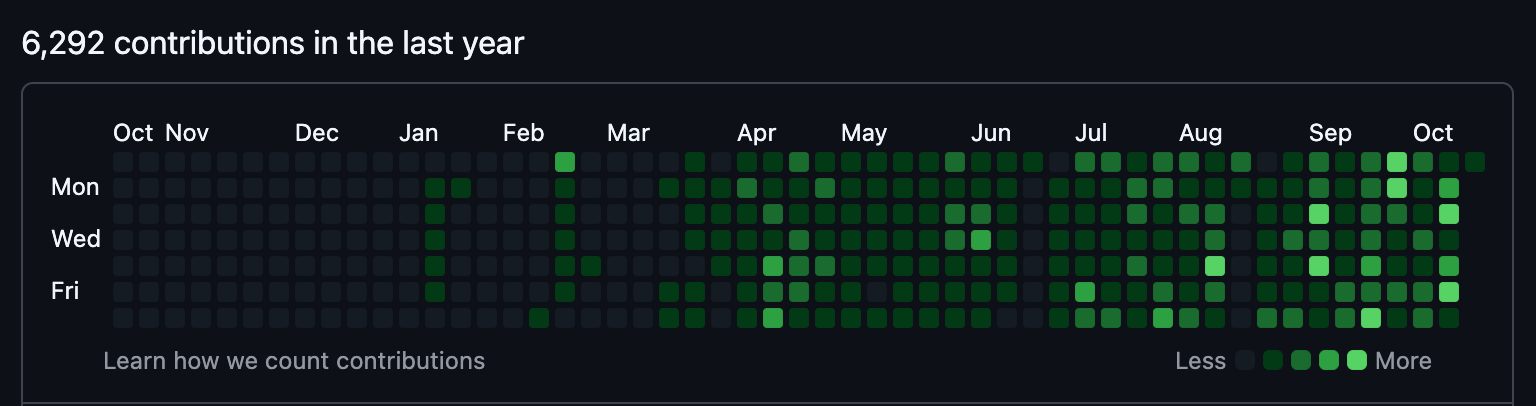
I’ve made over 6,000 contributions to github over the last 12 months, and for four of those months was inactive.
I’m building, prototyping, and shipping on a weekly and often daily basis. I’ve built stuff I literally dreamt of just two years ago.
Today, if you have a problem involving a computer, you can spin up an agent and build software to solve it. Most problems aren’t companies, but they are still problems.
Over the last month, two friends have told me about startup ideas. Being the entrepreneur and nerd in my friendship group, I’m often the one friends come to to discuss these sorts of things.
Both of these require some type of tech build. Two years ago, they would have both had to either (A) find an engineer to build it for them, or (B) create some lightweight non-real version of (MVP) to validate, then go raise money. If those ideas weren’t billion-dollar ideas, they wouldn’t get funded.
I told both of them the same thing: go spend 20 hours watching YouTube tutorials on how to build with Lovable. Then spend another 20 hours building it – you’ll have a working version by the end of it.
For two weeks of evenings hacking away, or a couple of weekends, anyone can now bring an idea to life. Maybe those ideas don’t go anywhere. Maybe they do but they’re just small ideas loved by a few hundreds or a few thousand people. Maybe they go on to be billion dollar businesses.
Before, unless you could write code, your idea had to potentially be worth a billion dollars to get funding for it.
The scope of what can be built now is many millions of times broader.
And remember, right now 99% of people aren’t doing this stuff. You can get so far ahead by experimenting now and the access to this is all free.
At least in the short term, the AI jobs apocalypse isn’t a thing


Yes, there’s a world post-AGI, post-abundance where we don’t need jobs anymore. But as that’s in the low probabilities of being a thing, I think its better to consider the extrapolations are where we’re at.
Last month, the Economist reported that AI has so far created one million jobs for 200,000 laid off as a result of it. Software engineering – the area which AI by far most affects – is seeing an increase in job posts. Other areas for employment most impacted by AI, are also seeing increases. And in the US at least, graduate unemployment has also been unaffected.
There are obviously counters to these stats too, job postings for junior roles are down – and the UK is disproportionately worse off than the US for areas impacted by AI. But the UK picture is less clear-cut than that survey suggests. Bloomberg Economics found that vacancies in AI-exposed UK roles were already falling before ChatGPT launched, and have risen since summer 2024.
Aaron Levie, CEO of Box, nailed this those.
The biggest misread of anyone predicting the end of software engineering was imagining that the world only needed a certain amount of software, and bringing automation to the field would reduce the need for labor.
Exactly the opposite is happening where essentially most things are actually turning into software. Because agents can use tools, work with computers, write software on the fly, and process data like humans (but far faster), we can now throw “software” at problems that never could reasonably be digitized before.
What that leads to is the role of engineering taking on greater importance in the economy, because we can now engineer far more systems and processes than were possible before.
Our hiring is up and will grow faster because of AI
Here’s what’s happened this year.
AI has allowed us to significantly broaden our service offering, improve quality in it, and afford better return for price
New business is 100-150% higher than last year, and same with MRR growth
Headcount has grown at a faster rate throughout this year than the year before – and is forecast to continue next year.
We have become exceptionally more efficient.
And we are also busier than ever.
This take on jevons paradox is amongst those I talk to – other founders, leaders – the AI paradox writ large.
The jobs are 100% changing
When you walk into our office, you’ll see 20 screens with VS Code or Cursor open.
A copywriter no longer simply sits at a computer and writes out lines of copy.
A video editor no longer simply sits in Premiere Pro and strings together video sources.
A paid social person no longer sits in Ads Manager and studies ad accounts.
A growth person no longer opens up Google Sheets and starts adjusting a model.
But those roles are all still present, its just their toolkits are radically altered.
And while not everyone dreamt of being a software developer growing up, often I find creative people have narrower jobs than they dreamt of. A video editor takes on the role of a creative director. A copywriter that of a cultural strategist and behavioural economist. The paid social analyst that of a CMO.
Our entire team now lives and breathes in Claude Code or Codex. But they are still their jobs. Their expertise and taste and judgement that got them to their roles is still the thing they need today.
I know that what I can build with AI will be a fraction of that which an actual engineer could achieve – at least in terms of quality and time-to-execute.
Similarly, I can be a video editor today using Opus 5.5. But give an actual video editor those tools, and the output is incredible to see.
It is still day zero
We may all be hitting out five hour token windows every few hours, but we are still at day zero. It is the yin and the yang, the anxiety and the excitement, which comes from the frenetic pace of development.
But every week, there is something new to learn, some new system to integrate, some new model to experiment with, some new process that could be improved.
I am absolutely blown away by how much our team has changed this year.
In our shared github, across all of our company repoes:
1.4m lines of typescript
988k lines of python
540k lines of html
374k lines of sql
133k lines of javascript
And outside of even out main databases (across BigQuery & Supabase), we also have:
68m lines of json and 4m lines of markdown
We are essentially now a tech company.
And yet, we are still at the very start of what the future looks like. The things we’ll achieve tomorrow will make what we managed yesterday feel small and prosaic.
Let’s be more ambitious


Andrej Karparthy wrote a couple of weeks ago about the widening gap of AI usage worldwide.
“So this is the weirdness of the moment. The general public has mostly not interacted with these systems. When they have, it looks like a derpy chatbot. The majority of professionals still see only a modest uplift. And a small sliver of professionals are experiencing the vertigo of the curve going vertical. And it is all happening at the same time.”
For those of us outside of the frontier, all we can aim for is to be in the top 0.2% of the population using AI agenticaly and radically.
Last week, Felix Rieseberg, an EM at Anthropic, wrote an article called How to be more ambitious: a tutorial for humans with models.
In it he reminds us of the story of George Dantzig, a statistic student at Berkeley in the late 30s. Late for a class one day, he copied some notes down from the blackboard, then handed it in the following week. He believed it to be the homework, had he have been in the class, he would have know they were two unsolved problems in statistics.
He had solved them. Because he hadn’t done the default human behaviour of believing we cannot achieve something.
We can do so much more than we believe we can.
Felix writes a great and practical framework for how to be more ambitious with AI that centres on four areas:
Speed: The same work in less time, the bread and butter for AI’s economic value: If you need some code written, I’ll do it faster with Claude. Well established and requires little creativity in how you approach AI, so I’ll skip this one.
Altitude: Going up in abstraction and considering the outcome rather than the individual task.
Depth: Considering a task the way a field-leading expert would. Rather than operating at the task’s layer, we go one level deeper and touch the underlying data, tools, and problems.
Range: Drawing on multiple fields rather than just the one the task might need at the surface, using knowledge, tools, and techniques you normally wouldn’t.
My rallying cry to the whole team was let’s be more ambitious.
Let’s pause work and reflect, and consider what we can do better: with more speed, altitude, depth or range.
It’s day zero, and I can’t wait to see what we can achieve today, tomorrow, and the next day.
I’m the founder of Ballpoint. We’re a growth and technology company that helps consumers brands scale to kill their competitions. If you’re stuck at a growth ceiling and want to triple your profitable spend over the next 12 months, then get in touch.