

Most brands that come to us have hit some kind of ceiling. They found customers on Meta, their spend grew… and then it stopped.
When we look into why, it usually comes down to one of two things, often both. Their ads all look and sound similar, so they keep reaching the same people. Or they haven’t yet found the message that makes people understand straight away what the product can do for them.
The obvious fix for the first problem is more ads, and making ads has never been cheaper or easier. With the help of AI, you can have a thousand ads tomorrow for less than the cost of a freelancer’s day rate. But volume on its own doesn’t get you far. A big slab of ads that don’t get at what customers really care about will find you the odd lucky winner and not much else.
What works is volume with clear strategy behind it. Every ad you make should start from an insight about a customer: something they told you, something you read in a review, something a previous test taught you. Then build outwards from there.
A few years ago, we were working with Mother Root to help them learn about their customers with interviews. In one of those early interviews, we heard someone mention the drink as an alternative to an end-of-day glass of wine. If you looked at their Ad Library a year later, you’d see that variations of that line resulted in thousands of ads.
In this post, I’m going to share our entire process so you can identify the messages that allow you to dramatically (and profitably) scale volume and spend on Meta.
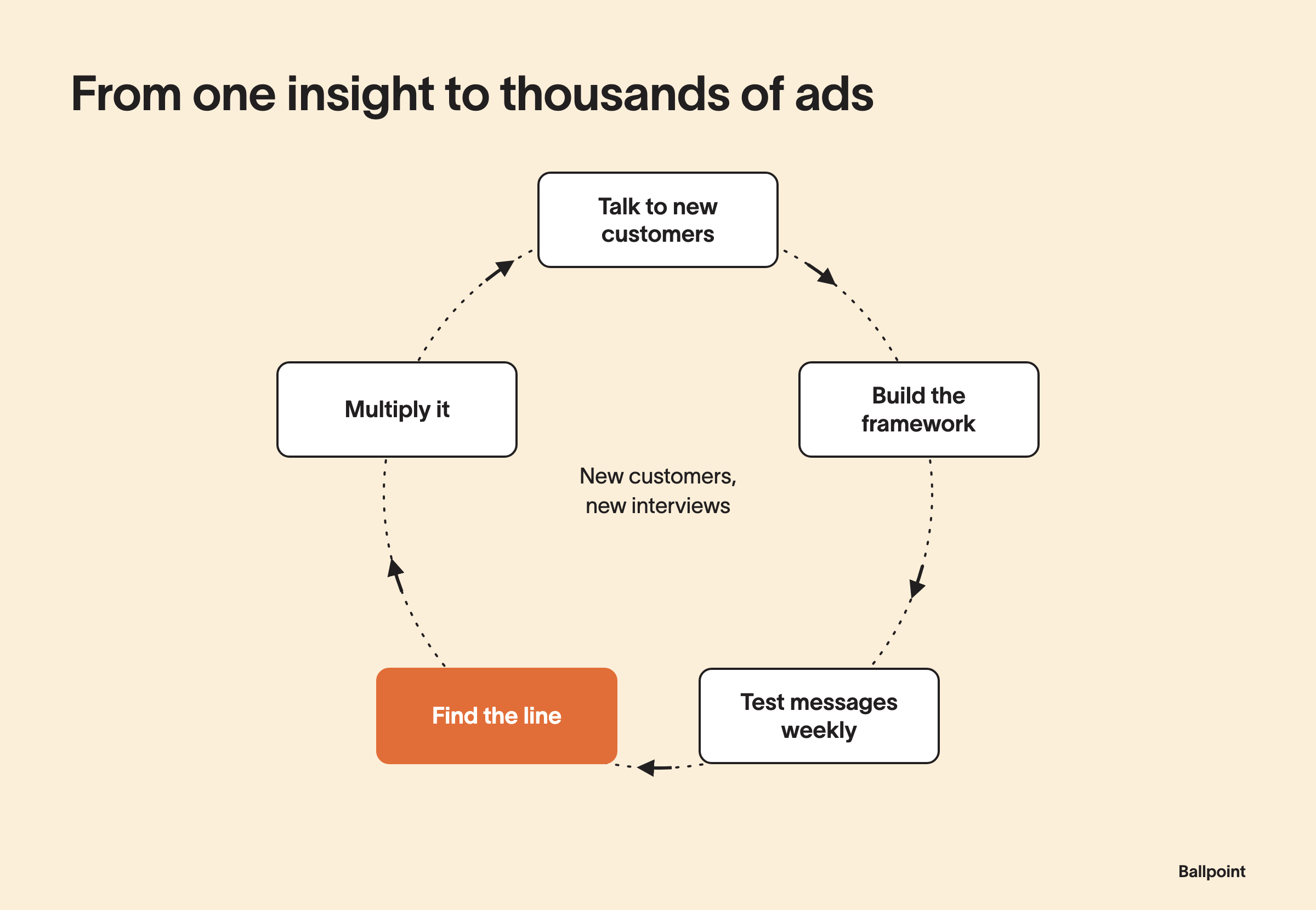
Step one: talk to brand-new customers
Everything starts with interviews. We usually run around ten with people who’ve bought recently, ideally in the last few weeks. We find that long-term customers have often forgotten why they purchased, whereas new customers can remember what was going on the day they finally converted.
The questions are pretty straightforward. What were you doing on the day you bought? What were you using before? What nagging doubt almost stopped you?
The most important thing is to record what people say, and dig deeper into the things that feel significant. A lot of the best-performing messages in our accounts are things customers said, occasionally reworked a little, and not much else. Customers can describe their own problem in more precise terms than a copywriter who isn’t a customer (though the best copywriters know a good angle when they see it).
So imagine our blanket brand runs ten interviews. By the end, there’s a page of lines like these:
“It’s the only thing that switches my brain off.”
“I’ve stopped scrolling on my phone until 1am.”
“It feels like being tucked in when I was little.”
“My partner says I’ve stopped kicking him in the night.”
“I wake up feeling like I’ve slept properly.”
Write them all down. At this stage you don’t know which (if any) will make for a good ad. That’s what testing is for.
Jobs, not personas
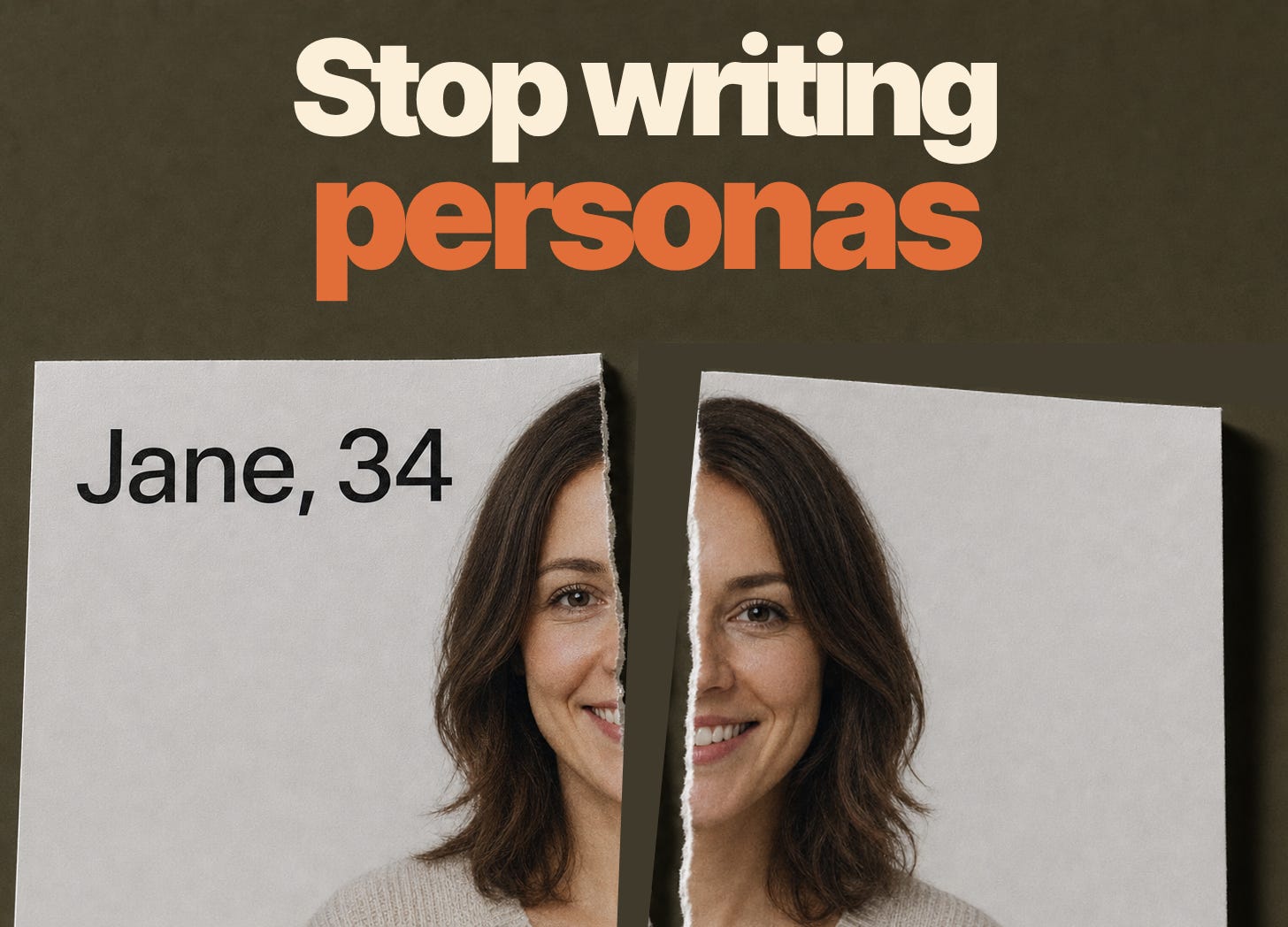
The commonest next step would be to take those interviews and build personas like “Jane, 34, lives in Leeds, likes yoga and true crime”. But personas aren’t very helpful.
A persona describes who someone is. A job describes what they’re trying to get done. Two people with nothing in common demographically can buy the same product for exactly the same reason, and two people who look identical on paper can buy it for completely different ones.
Step two: build the customer framework
Your customer messaging framework puts everything you know about your customers in one place: what they’re trying to get done, what pushes them to act, how much they already know and what’s holding them back. It’s a living document, and we build one for every client before we write a single brief.
It’s essential because interview notes on their own get lost in transcripts, and briefs can easily drift back to whatever the strategist is feeling that week (or, very often, “let’s try an ad like this one from your competitor”). The framework turns your research into something you can plan creative from, so every ad can be traced back to something a real customer said or did.
Interviews feed into it, but they’re not the only source. Also pull in reviews, Trustpilot, Reddit threads, support tickets and anything else that tells you how people talk about the problem, plus the results of every test you’ve already run.
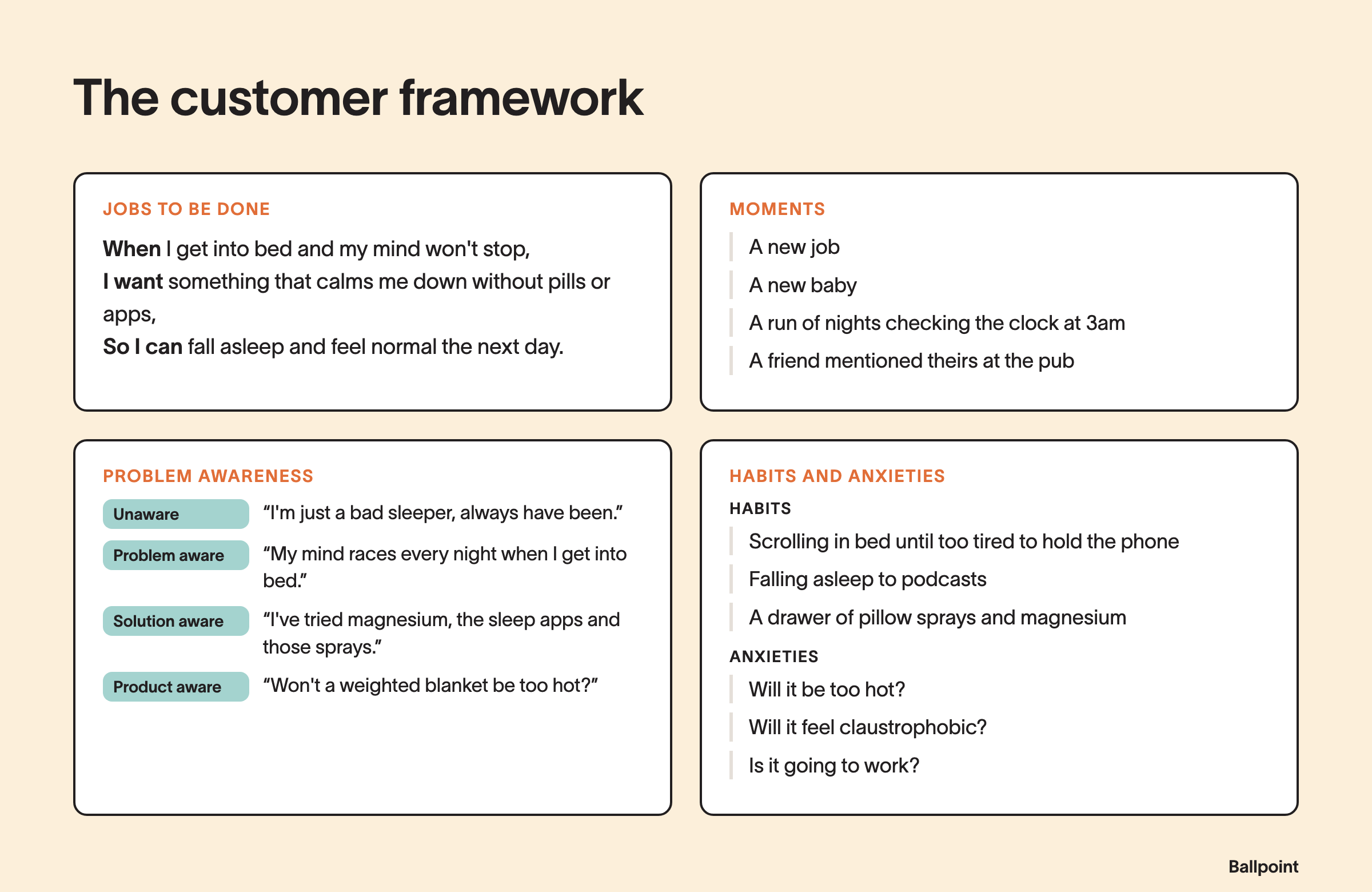
The framework has four parts. Here’s what each one is for, and how the blanket brand’s might look.
Jobs to be done. These are the core of everything. Each one is a short story about what someone is trying to achieve and why: when I’m in this situation, I want this, so I can get this outcome.
When I get into bed and my mind won’t stop, I want something that calms me down without pills or apps, so I can fall asleep and feel normal the next day.
Moments. These are the moments that take someone from thinking about a problem to being ready to do something about it. Plenty of people sleep badly for years without buying anything. Then something changes: a new job, a new baby, a run of nights checking the clock at 3am, a friend who mentions theirs at the pub. If an ad can meet people in that moment, it’s far more likely to resonate.
Problem awareness. This is where someone’s head is at different parts of their journey to finding your product. You talk to a person who thinks they’re “just a bad sleeper, always have been” very differently from someone who’s “tried magnesium, the sleep apps and those sprays, and none of them did anything.” The first person needs to hear that their problem can be fixed. The second needs to hear why your solution is different.
Habits and anxieties. Habits are what people are doing now instead of buying the product. How are they dealing with the problem at the moment? Ignoring it, scrolling in bed until they’re too tired to hold the phone, buying a pillow spray? Understanding that lets you reflect their own situation back to them. Anxieties are the things that stop people from converting: will it be too hot, will it feel claustrophobic, is it going to work? They’re especially useful near the bottom of the funnel, where someone is interested but hesitating.
Put the interview lines next to the framework and some start to look stronger than others. “It’s the only thing that switches my brain off” is the job in a single sentence, and it answers the biggest worry, which is whether a blanket can help at all. “I’ve stopped reaching for my phone at 1am” speaks straight to the scrolling habit. “It feels like being tucked in when I was little” is a nice line, but it’s more about a feeling than the problem. The strongest candidates tend to touch several parts of the framework at once. That still doesn’t tell you which will win, but it tells you which to test first.
Two more things help decide the order. Some things come up again and again across interviews, reviews and Reddit, and the ones that come up most often should be tested first. And a good creative strategist develops a gut feel for this. Some lines just sound compelling the moment you hear them, and those deserve a place near the front of the queue too.
The framework isn’t a workshop document that gets filed away. Every new round of interviews updates it, and so does every finished test. Each entry starts as a hypothesis. If you run an ad built on an anxiety and it wins, that’s a good sign the anxiety is real, and it moves towards validated.
That makes the framework the source of truth for every creative test you run, from the first week to the hundredth. It means there’s sound reasoning behind every ad.
Step three: test messaging first
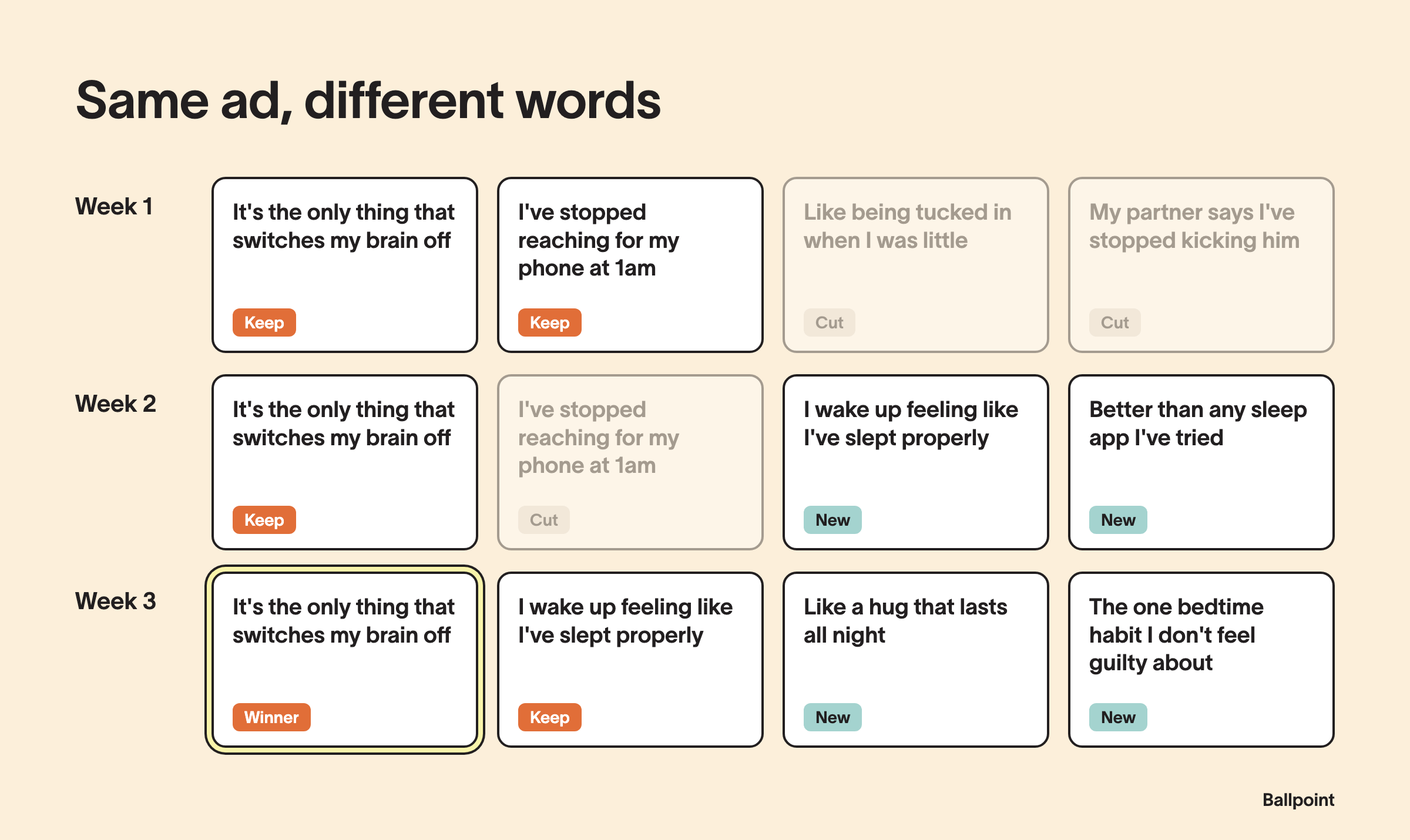
For the first round, pull the strongest phrases out of the framework and turn them into headlines. For our weighted blanket brand, that means the interview lines above, plus a few from reviews and Reddit, such as “Like a hug that lasts all night”.
Then test the messages, and only the messages. Run these tests on simple static ads: same image, same layout, and only the words change. Statics are quick and cheap to make, and they let you isolate the one variable you’re interested in. If you test a new line inside a brand-new video with a new creator and a new hook, and it wins, you’ve no idea which of those things did it.
We work in weekly sprints. A batch goes live, we read the results after about seven days, keep what’s working, cut what isn’t, and feed in new lines from the latest interviews and research. Then we go again.
In our example, three weeks in, “It’s the only thing that switches my brain off” is still standing while the other lines have come and gone.
How do you know when you’ve found the killer line?
This is the hardest question in the whole process, and the one we spend most time arguing about.
The first sign is a line that beats the others when the message is the only thing that’s different. The second, and more important, is that it keeps winning when you move it into other formats. If a line only wins on one particular static, you might have found a good static rather than a good message.
The best sign of all is what it does to the account. A message that lets you scale spend without your CPA climbing has done something the others haven’t.
But even then, you can’t know you’ve found the best possible message. You only know it’s better than everything else you’ve tried so far. There’s no way to see the ceiling. A line can comfortably outperform every other ad in the account and still be beaten by one you haven’t thought of yet.
That’s why we keep a portion of every week’s testing on new messages, even when It looks like we’ve cracked it. With one client this year, around 80% of testing went on taking messages we knew worked into new formats, and the other 20% kept looking for a better message in case we hadn’t found it yet.
Step four: multiply
Once a message has fully established itself as a winner, the process changes. You stop asking what to say and start asking how many ways you can say it.
This is where diversity comes in. On Meta, you don’t really choose who sees your ads any more. We run almost all of our consumer accounts fully broad and let the algorithm find the people, and the main thing it uses to decide who sees what is the ad itself. Your creative is your targeting.
That means there’s no single best ad. There are ads that bring in certain kinds of people and other ads that bring in other kinds. People respond faster to things that feel familiar: their own language, their own surroundings, the kind of content already in their feed. And two ads with the same words and the same visual template are, as far as Meta’s concerned, basically the same ad. They’ll reach the same people.
So a great line on its own isn’t enough. A new parent who hasn’t slept properly in months might stop for a calm, slow video of someone getting into bed. A student with exams next week might scroll straight past that and stop for a meme. The line is the same in both, but they’re different ads for different people.
Format matters much less than most briefs assume. Post-its, polished brand videos, founder-to-camera and lo-fi phone notes all work and all fail. The message stays put while everything around it changes, and the testing tells you which formats carry it best for which people.
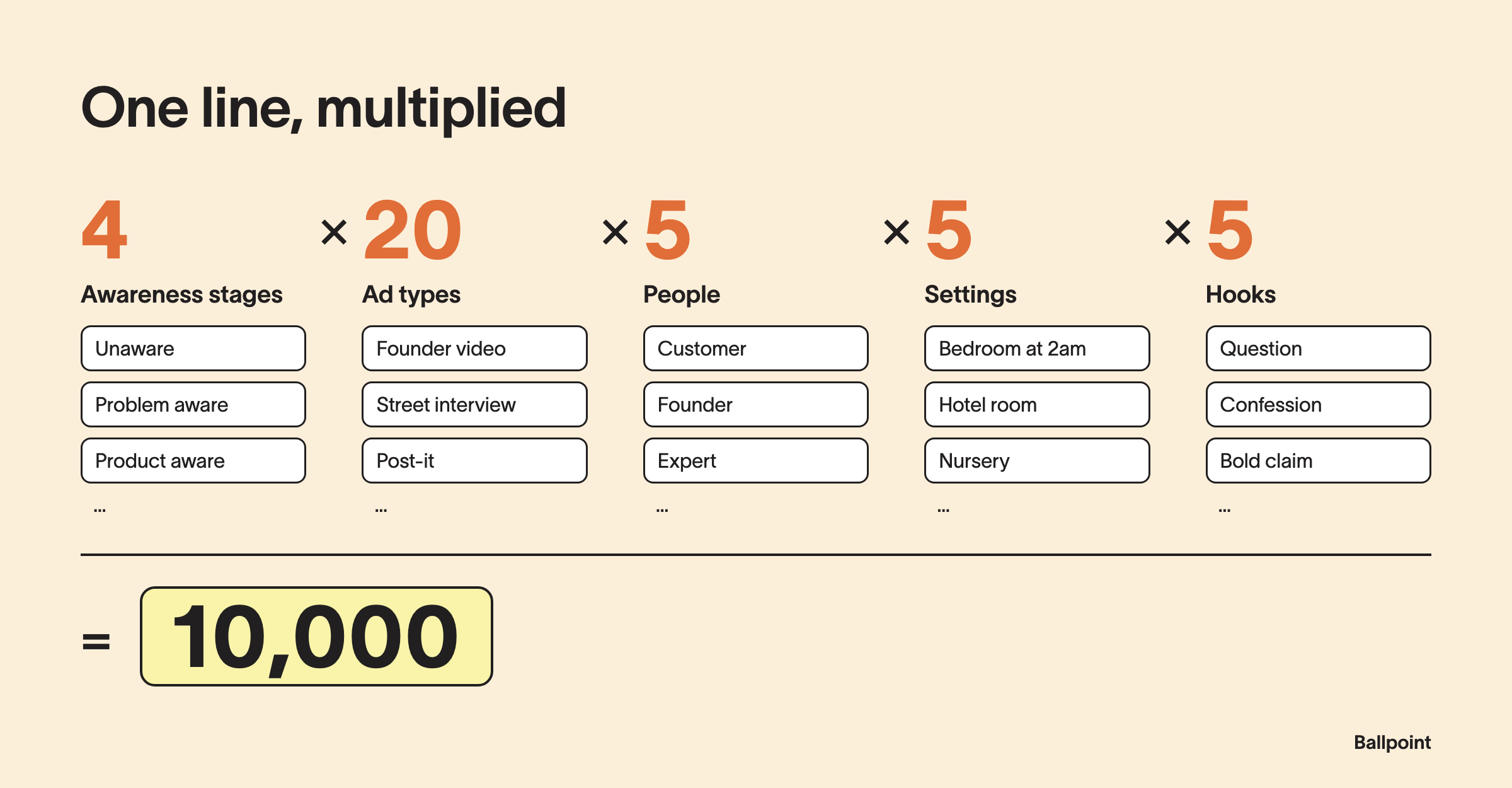
Here’s where the hypothetical 10,000 comes from. Take one line and multiply it across:
4 awareness stages. Someone who thinks they’re just a bad sleeper needs a completely different ad from someone who’s already tried every sleep app going.
20 ad types. These are the ones we check for in every account audit: founder videos, street interviews, comparisons, before-and-afters, podcasts, testimonials, post-its, native-looking statics and so on.
5 people. A customer, the founder, a creator, a sleep expert, someone’s partner who’s finally getting a decent night too.
5 settings. The bedroom at 2am, the sofa, a hotel room, the office the morning after a bad night, a new parent’s nursery.
5 hooks. The first two seconds, which decide whether anyone sees the rest.
4 × 20 × 5 × 5 × 5 = 10,000.
Obviously these numbers are rough, but you can see how it’s possible to get 10,000 ads from one killer line.
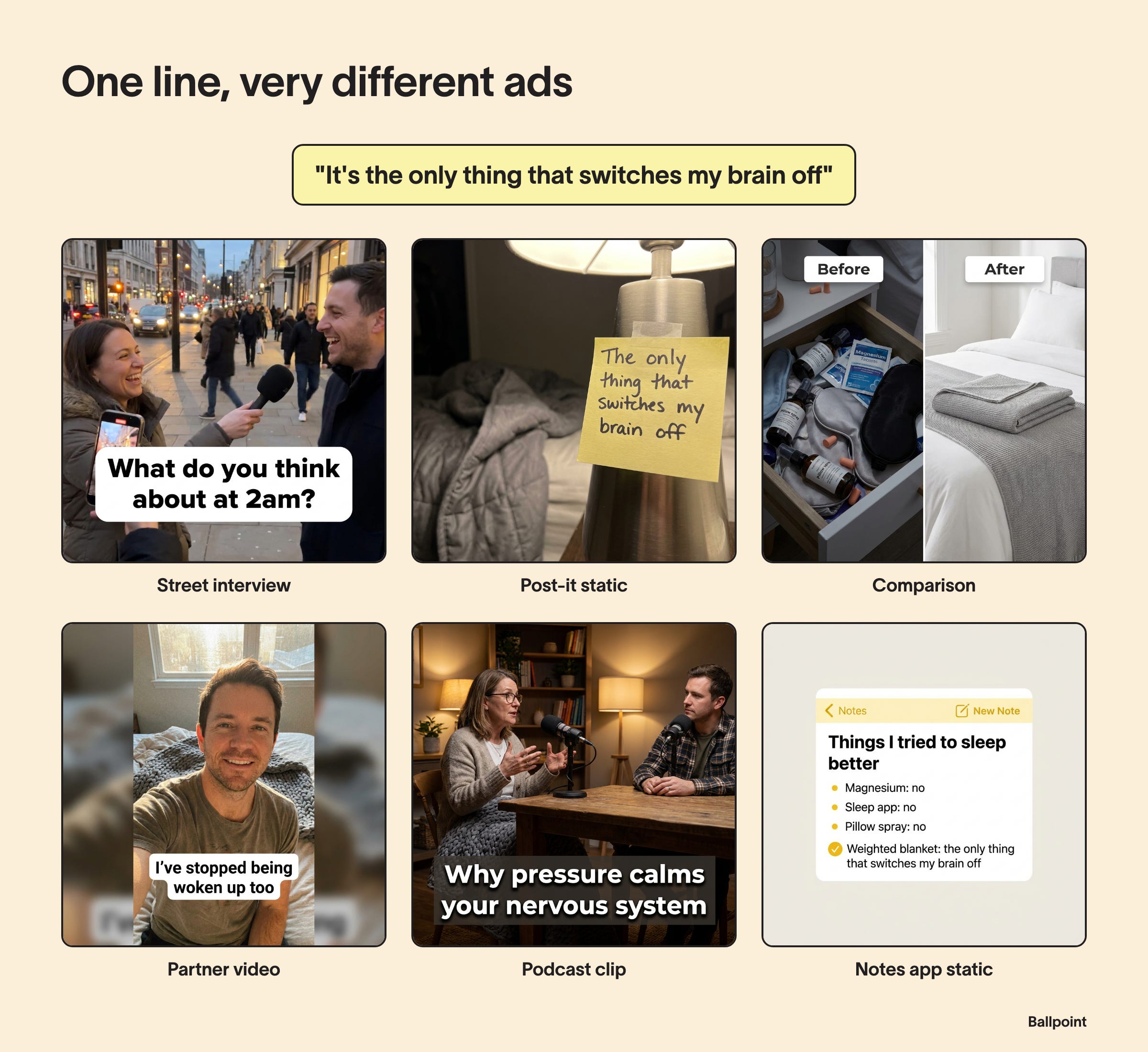
Every cell in that grid is a distinct ad that could reach somebody the others don’t. A few examples of what the blanket brand might make:
A street interview asking people what they think about at 2am, cutting to someone saying the line.
A handwritten post-it on a bedside table: “The only thing that switches my brain off.”
A comparison static: the drawer full of sleep sprays and magnesium tablets next to the blanket.
A partner talking to camera about how they’ve stopped being woken up by the tossing and turning.
A podcast clip with a sleep expert explaining why pressure calms you down, with the line as text over the top.
A static made to look like a Notes app list of everything someone tried, with the blanket as the only thing that worked.
Rinse and repeat
Even a great line wears out eventually, or at least its current versions do, usually faster than you’d expect. New ads bring in new customers, and new customers have new reasons for buying. So you interview them, update the framework and go looking for the next insight.
Closing thoughts
When we talk about the idea that creative is how you win paid social, what we really mean is the message. We’ve seen this process work dozens of times now, from pre-product-market-fit through to legacy brands looking for new audiences.
Let me know how you get along. And if you’re a weighted blanket startup, give us a call.
I’m Mark, Head of Creative Strategy at Ballpoint. We’re a technology-enabled growth agency helping brands triple their profitable spend every year. If you’ve got a growth problem, hit us up.
LOVE LOVE LOVE this Mark. Thanks for sharing.