
My framework for diagnosing growth failures during wartime. What to do when CPA stays bad.
Plus an introduction to wartime growth vs peacetime growth.

We run experiments every single week. Experimentation is our default mode. But sometimes things come up that require deeper exploration.
It usually happens like this: performance has gradually been heading in the wrong direction. First, you rightly ignore it as these things usually work themselves out. Then it starts to become a trend but you still allow it. And finally, it becomes something you need to pay attention to.
At this point, the usual run of experiments won’t cut it.
I re-read Ben Horowitz’ A Hard Thing About Hard Things last November and one of the best chapters remains Peacetime vs Wartime (I wrote about wartime before product-market fit three years ago).
What I’ve come to realise is growth fits into these two modes of peacetime and wartime as well.
Wartime growth is when you don’t have performance in the right place
Wartime growth is not having product channel fit
Wartime growth is not having product market fit
Wartime growth is not finding marginal sales as you scale
Wartime growth is being unsure that your ads are actually delivering sales
Wartime growth is not breaking even in time for your cash flow – or ever
Wartime growth means your creative win rate is 5-10%
Wartime growth means brand guidelines must be ignored
Wartime growth you are holding spend flat while you figure things out
Wartime growth is trading off no statistical significance for big bets
Wartime growth is maniacal focus on getting CPA to a good place
Wartime growth is not having marketing calendars
Wartime growth is wholesale landing page swapping
Peacetime growth is when you are scaling
Peacetime growth is about relentless creative operations scaling
Peacetime growth is having a Job Story and angle that *works*
Peacetime growth is 80% finding new concepts to demonstrate that core JTBD
Peacetime growth is loosening efficiency so you can scale hard
Peacetime growth is aiming to triple spend in six months
Peacetime growth is measuring all creative by £ spent on it
Peacetime growth is allowing room for brand consistency and design
Peacetime growth is small, incremental CRO experiments
Peacetime growth is statistically sound data
When you’re in peacetime, experimentation is how you grow.
When you’re in wartime, experimentation is how you survive.
Every business starts in wartime, then if you’re lucky, you have some period of peacetime until inevitably you fall back into wartime again. And the cycle continues.
I’ve previously described these as ceilings and growth spurts in an S curve. But I’ve grown to realise a ceiling feels too gentle; these are cycles of peace and war.
Experimentation is always urgent because no matter what state you are in, it’s the way out. But during wartime, it requires that you go back to the drawing board and begin with first principles.
I write twice weekly here every week. This is the weekly Tuesday essay: a key learning from my 16 years experience growing consumer businesses. Every Friday is a weekend debrief: key stories, stats, and reads for the weekend.
Posts are (currently) free, but the archive is paid.
Subscribe as a paid member for full archive access now.
Diagnosing problems during wartime
“I thought your customers were 50+ females?”
I was auditing an account recently for a brand spending about £3m a year. During the early sales calls they mentioned who their target customer was the 50+ female. Hallelujah I thought.
The 50+ female is the holy grail for advertisers. The 50+ female still uses social, she over-indexes as a Facebook user (a platform still underserved compared to IG). She is both rich and part of a high earning household. And she’s the primary shopper.
But as we got into the account I pulled the breakdowns. (Sidebar, I can’t believe Meta still give us breakdowns, use them while you can).
2026, year to date, 35-44 is the biggest demo for spend, reach and purchases and not by a small amount either. Yes there’s a female skew, but it’s pretty marginal.
We extended the search back further and looking at the monthly trend saw their 55+ demo halve from 40% of spend to less than 20% over the course of 18 months.
We’re no longer in peacetime.
So what does experimenting in war look like?
Begin with my Hypothesis Matrix to analyse why something changed
A while back, I came up with a simple matrix for diagnosing big changes in performance.
It’s a two-by-two grid with Location along the x axis (External / Internal) and then Ownability on the y axis (Ownable / Out of our hands).
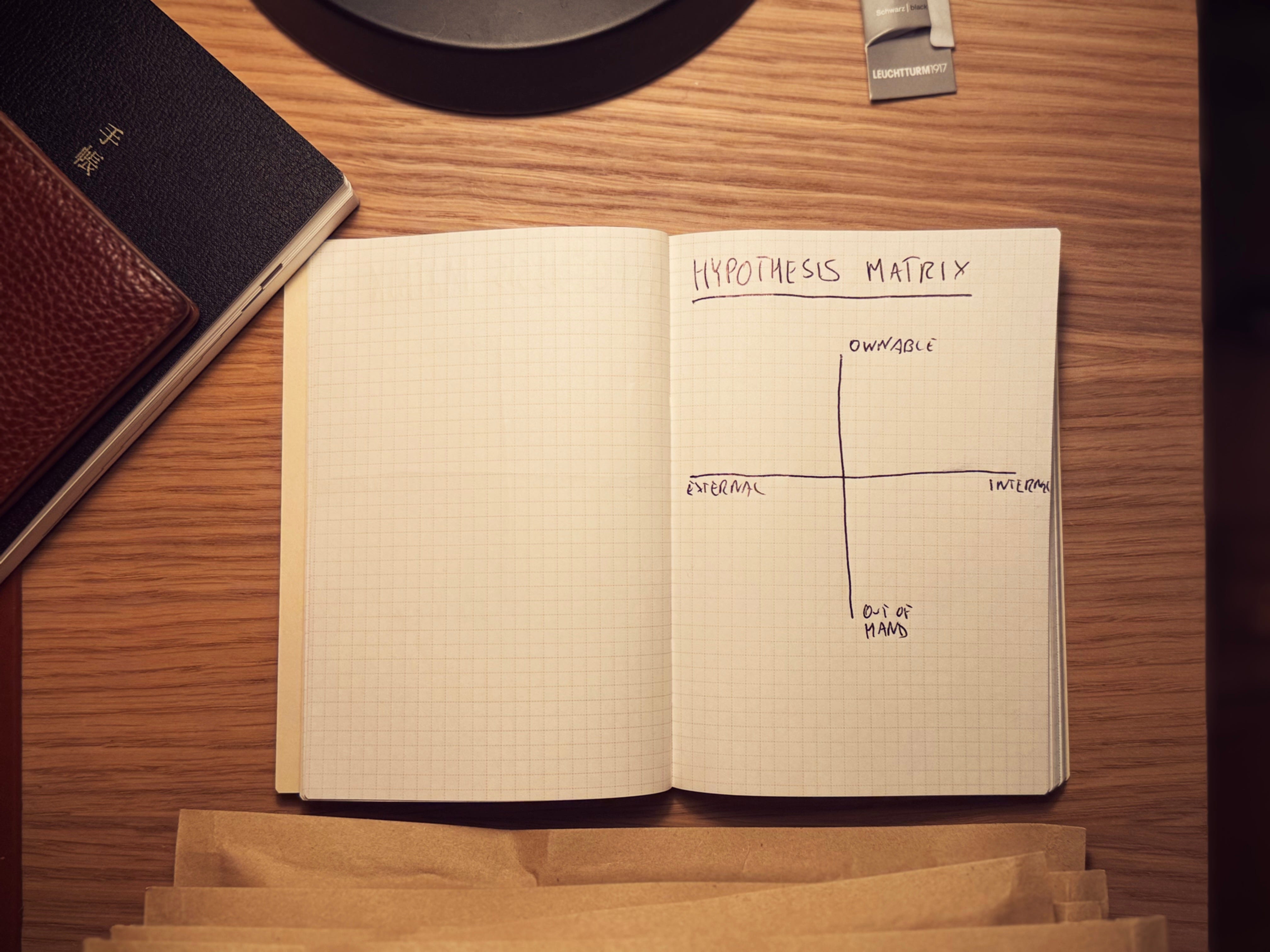
Key question above this grid – “Why has the audience shifted?”
In the external and out of our hands, I wrote down:
Tax / budget concerns
Less FB usage in category
Meta algorithm shift
In external but ownable, I wrote:
New competitors
Run out of customers
Shift in social media trends meaning creative no longer works
Shift in social usage to different placements
In external and on the border I put:
Culture shifts away from product category
In internal and out of our hands, I put:
Price increases last year
In internal and ownable, I wrote:
Creative
Campaign setup
Any brand changes, rebrand, redesign etc (?)
Landing page / website changes (?)
Messaging changes (?)
Email onboarding flows (?)
”Don’t ever come to this meeting blaming external factors again”
In the early days of my career I was in a meeting one August when someone offered up “it’s summer” as an answer to why performance was down. Said colleague was quickly dressed down by the CEO for using the external factor.
That stayed with me ever since. The tone was obviously curt, but beneath it was an important message. The mindset of diagnosing problems should always start within.
And so whenever I fill in my Hypothesis Matrix, I always start with the top-right: internal and ownable. And while I do also write down client-side changes in that quadrant, I always begin by listing out stuff that we, Ballpoint, own first of all.
Under creative, we can start digging even deeper.
Is it because we’ve stopped producing a certain visual hook? Or maybe all of our videos have switched to 15 seconds whereas this audience likes 45? Have we changed the type of creators we use? And so on and so on.
Once I’ve got my initial draft done, I’ll go to the client and ask for what they think it could be. I’ll begin by talking through the Ballpoint-ownable hypotheses we have, before going into some examples of others we had.
Data gathering and experimentation
Now, we switch into the next phase: data gathering and experimentation.
Another peacetime/wartime distinction:
In peacetime, getting insights and gathering data is usually about finding extensions of what you know. You might dig through Reddit to unearth a new framing of your problem. Or maybe a customer interview revealed a slightly different catalyst for your Job Story.
In wartime, you need to go deeper.
Every hypothesis on the matrix requires some digging.
At this point, you need to apply pressure and fast. You don’t have time to analyse everything. Fortunately with Claude, much of this data is quicker to get than it was a year ago. But still, there is such a thing as too much data.
Example data explorations
Back in Jan, we saw damp performance in some accounts. I blogged about some of those findings, in particular that health behaviours had changed significantly this year. Dry Jan isn’t a thing now, protein for women is on the rise, and we’re moving towards strength over skinniness as the ultimate in high status.
We might explore if competitors have started using big influencers or launched a TV campaign, or perhaps they’ve launched an offer that’s just dominating.
We dig deep enough to form mini-hypotheses at an experiment level. And then we begin creating experiments around those ideas.
Prioritising experiments with Impact-Probability (IP) and Expected Value (EV)
At this stage, I like to evaluate expected values using our Impact-Probability (IP) framework. This is a simplified version of the infamous ICE frameworks.
Impact is the degree that change could shift your problem
Probability is what % likelihood you have that result will happen.
Let’s say your core metric you optimise towards is contribution margin.
Impact you should define as what potential uplift that would have in CM next month.
Let’s imagine one experiment hypothesis means you could double your conversion rate meaning based on next month’s forecast you increase contribution margin by £250k.
But the probability of that happening sits at 20%. This puts the expected value of said experiment is £50k.
Expected value (EV) = Forecast uplift in key metric * Probability of event occurringMaybe you’ve got another experiment you’re debating running which can only generate £75k of CM gains but you’ve got 80% probability of success.
EXP01 EV = £50k
EXP02 EV = £60k
Start with number 2.
The last resort: owning the unownable
In grave situations, you may well exhaust all of the lovely top-right quadrant of ownable and internal problems.
It’s at times like this that you usually need a total strategy reset. Perhaps your core customer has really radically changed. Maybe you’re selling wine to an age bracket that thanks to a really big influential movement has gone 15% teetotal.
Out of our hands ideas can become ownable with a strategy shift.
And you can turn external factors into internal ones with a revolution as well.
But these changes don’t come cheap.
I hope you’ve found this useful.
I love experimentation. It’s one of our founding philosophies at Ballpoint. But it’s taken three years to identify these two distinct states of business. There is wartime and peacetime growth. And the model for experimentation during those phases is entirely different.
If you want help pinpointing whether you’re in wartime or peacetime, then drop me a line. Or better yet, start a discussion in the comments below.
I’m building Ballpoint: the growth agency I always wanted to hire when I was a DTC founder and before that a head of growth. We have scale brands from £1m → £50m through digital advertising. If you’re looking for support, then you can email me on josh@weareballpoint.com.
In the meantime, if you enjoyed this please consider giving it a like, a comment or forwarding it to a friend.
Really valuable perspective!
Wartime leadership is SO addictive. When the business is in crisis, your presence as a leader is legible; every decision runs through you, the organisation needs you in a way that is immediate and visible, your salary justifies itself daily. There is great comfort and clarity in that.
I've seen so many leaders stay in wartime mode long after the war is over. But organisations (and people) cannot sustain crisis mode indefinitely. The cost accumulates slowly and then all at once — in burnout, in a culture that never learns to operate without the leader at the centre of every fire, in growth that keeps getting deferred because the team is still in survival posture.
Do you think switching to peactime asks leaders to become less central?
If you have signals (assuming you know what they are) that you are in peactime, but choose to run wartime plays, isn't the most courageous thing to ask whether you're the right leader for what comes next?
Asking as I've seen both mistakes made. Staying too long in wartime and never making it to peacetime at all.
I'd love to know which mode you find hardest to leave