


Today I want to talk about the dangers of chasing new shiny objects. Or what some call “Shiny Object Syndrome.”
Before I warn you off with the reasons why, I want to kick off by saying: I get it.
New stuff is fun. I should know, I work in advertising. And as any Mad Men fan will tell you, new is what works in advertising.
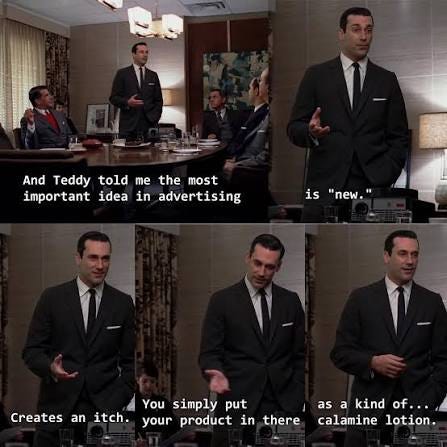
But “new” is not just fun, psychologically we’re predisposed to the “new” thanks to a cognitive bias called the ‘novelty effect.’ Our brains are hardwired to appreciate it.
Instead, the most important thing you can learn: is focus.
Today, I want to share some experience, data and and guidance that will hopefully help you replace shiny objects with focused mindfulness.
The desire for new markets, new products, new channels
In growth and startup land, shiny object syndrome presents itself in a few ways. One is often in creative, but while creating a yapper because you’ve seen it on LinkedIn might be a distraction, it’s ultimately a temporary, quick, and cheap one.
The biggest causes for concerns are:
New channels
New products
New markets
Purdy & Figg’s Jack Rubin posted this great quote a few months ago.
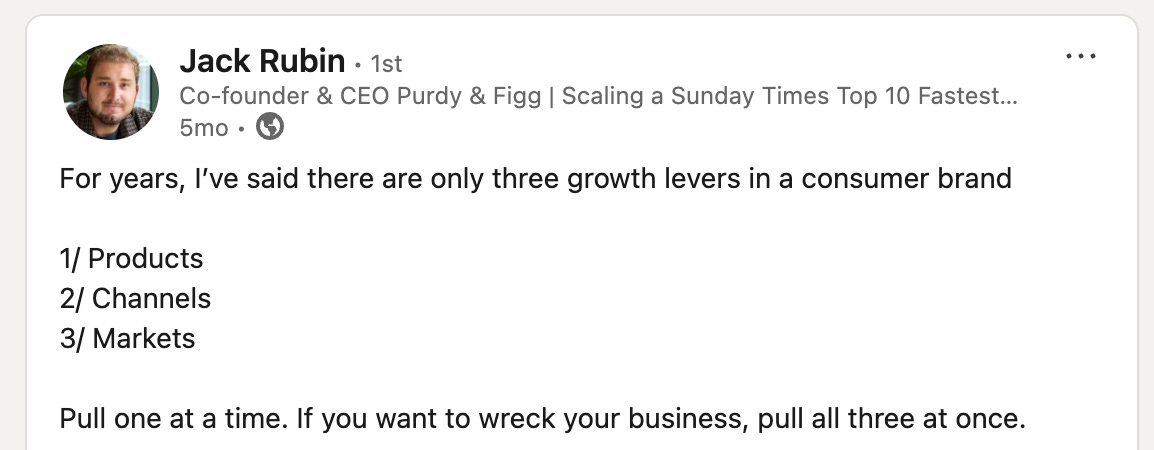
And if you wonder how well Purdy & Figg are doing, then know that their last filed Accounts, for the year March 2025 reported £39m of revenue up from £18m the year previously. And for most of that time they were: single product, single channel, single market.
Where does this pressure come from?
VCs
“How are you going to diversify away from Meta?”
I was asked this by a VC when I was running my last DTC startup.
With hindsight, what I should have said was: “we’re not – if we can’t get Meta to scale to £25m turnover in the UK, we probably don’t have a business that is going to make the return you need from it.”
But at the time, I was less experienced and I remember thinking ‘hmm maybe we should?’
Diversification doesn’t only come from VC pressure, but I do hear it perioidcally from that community.
Ego
Before I joined Thriva as first employee in 2017, I applied for lots of roles where I had to put together case studies/marketing plans.
There were two I remember getting really excited about.
One I would have been overseeing their new TV campaign and helping think about measurement for it. The other, we were going to invest over £100k in content marketing.
Both would have had really cool deliverables. Things I could have stuck on my CV or LinkedIn and would have got lots of likes.
But, again with hindsight, the probability that those things would have turned those businesses around is like close to 0.
The truth was a lot of why I wanted to do those things was ego. If it goes well, you’re a hero. If it goes badly, hey you tried. And if nothing else you’ve got great stuff you can share and show people.
You’re at a growth dreaded ceiling
Now perhaps the most legitimate reason you have is that you’re at a growth ceiling.
I.e., you’re trying to push growth in your current conditions and for whatever reason you just can’t scale.
I used to include this slide in our pitch decks
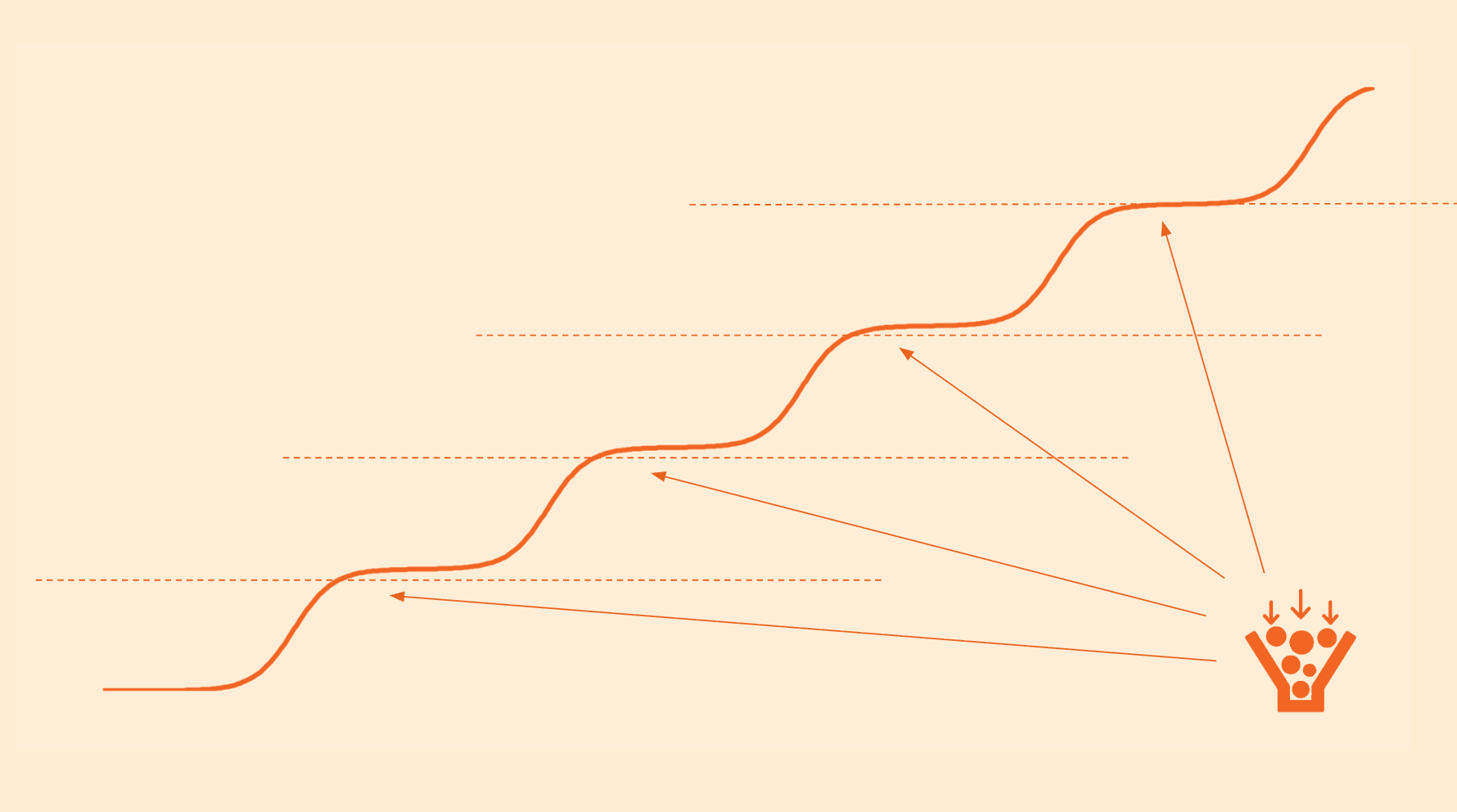
The point was to show that growth is not a hockeystick curve but it’s actually a case of:
You potter along not doing much
You land on something that works and it scales hard and fast
You hit another ceiling and you keep pottering along
Repeat
And at each of those stages, you try to identify bottlenecks. And it’s true that product, market, and channel are all bottlenecks. But the one that most people ignore is your core growth engine.
Experiment results from introducing complexity
Growth is probabilistic.
And so while the ‘focus’ argument is our default one, it’s also important we test ourselves perioidcally. And so, we’ve got a handful of experiments over the last 3.5 years from clients where complexity is added in different ways.
Given this, I wanted to share a few core hypotheses and the number of data points for and against we have. Here are the hypotheses/truths we now hold::
“More products or choices on site lowers the conversion rate”
We’ve tested this systematically across eight clients. Three of those clients we’ve attempted this multiple times.
The range of things here include: different flavours, product changes that suit entirely different customers, bundled extras, different payment tiers, and brand new adjacent products in a category.For: six clients supporting the hypothesis across 10 experiments.
Against: two clients against the hypothesis across two experiments.
In the ‘against’, we have one new flavour, and one bundled product extra that delivered significantly more value for the end-user. Every other instance resulted in lower conversion rate, higher CPA, worse CM3.“Diversifying product mix on paid social increases CPA”
This can happen as above when a new product launches, but often it comes from when a client asks ‘can we advertise these extra products we have.’ It feels like an easy win.
Except, as with the above, more often than not it results in overall higher account CPA. But worst of all it diminishes the ability for us to learn and produce rocketship ads.
For: five clients supporting the hypothesis across nine experiments.
Against: two clients against the hypothesis across two experiments.
The two ‘against’ clients were both brands with very large product catalogues (500+ SKUs). All of the ‘for’ were those with product catalogues under 30-50.“Forcing a bigger first basket reduces conversion”
This is often a result of either enforced bundling or adding extras that push people to higher purchase value.
For: three clients supporting the hypothesis across three experiments.
Against: one clients against the hypothesis across one experiments.“Introducing a new channel will increase CPA and decrease CM3”
We’ve tested TikTok nine or 10 times over the last 12 months. We’ve tested Pinterest twice. We’ve tested Reddit three times.
One TikTok tests improve overall performance and proved to bring great CPA. But every other channel test over the last year has been a fail.“Introducing a new market can work if the timing is right”
The last one is one where the idea is sound, but timing is essential. We’ve run six US launches over the last 3 years. Three worked, three didn’t.
Here the ones that worked were all brands spending over £100k per month consistently and had been doing so for a long time. They were also all brands that were profitable in the UK.
The fails were all spending well under £100k, and were not yet at break-even in their core market.
Of the ones that worked, one was almost instantaneous, the other two took six-to-twelve months. The three ‘fails’ we’re still trying to work on one, while the other two we’ve refocused efforts back to the UK.
You don’t need ebit profitability to make the US work. But you should go into it when the timing is right. Having a solid engine that is scaling healthily in the UK is important.
Being profitable is even better. Why? The US is expensive. Expect CPAs to be 10-50% higher. AOVs will be too, but at what cost to cash flow?
Not only that but there are big behavioural differences between markets. The US likes to be sold to more aggressively than the UK does. Your premium brand-focused lifestyle imagery is not going to cut it in the US. You need creator content being super explicit about what problem you’re solving for them – and everything adjacent to it.
Keep focus, stay calm and improve your core offering
Complexity can kill businesses. In the examples cited above, we had strong and clear experiment conditions where we’d pivot away.
Improving the growth engine is tough. It’s unknown. You have no idea whether you’re truly at a ceiling or you just haven’t found the latest thing that breaks through yet.
But it’s also where most of the time the magic happens.
Your core is also where the majority of all future revenue comes from. Secondary channels and products rarely make as much as the core one. And while a US launch does have the opportunity to help become the number one, it’s by no means gauranteed – and it’s bloody expensive to get right.
If you’re VC-backed, the chances are they’re looking for you to do £100m in turnover. If you’re not able to spend £150k per month or do £10m of turnover based on a single product, single channel, and single market, then you’re probably not going to make it to £100m either.
If you’re not, then this stuff is less relevant. If you’ve hit a ceiling at £2m of turnover, then maybe that’s fine. Only you will know if you can build the outcome you want at that level of turnover.
But know that the journey beyond your core focus is going to grow you slower. Diversification should feel like the beginning of a whole late-stage era of your business, not an early one.
Don’t get yourself into situations that are irreversible. Protect your runway. Protect optionality.
Eyes on the prize. Stay focused, and you might just find a second lease of life (and third, and fourth, and fifth).
Josh Lachkovic is the founder of Ballpoint, a creative growth agency helping you scale ad spend from £50k to £500k per month. If you’re looking for support, then get in touch.